“Every oak tree started out as a couple of nuts that decided to stand their ground.” -unknown
Hi Everyone! Welcome to fall, the start of a new season and also the start of a brand new month! I hope you are enjoying the change in colors and hopefully cooler evenings! I trust your week is going well. Thanks for being back! Tonight we start a new series “All About Nuts & Seeds.”
Moderate use of nuts and seeds in the diet can add variety and nutrition and supply good plant-derived fats with no cholesterol. The fatty acids nuts contain are high in beneficial monounsaturated and polyunsaturated fats, which form part of the molecules that move cholesterol through the bloodstream. NOTE: they should still be eaten in moderation due to their high caloric content. Butters made from nuts are very close in nutritive value and fat content to whole nuts, so you should use nut butters also in moderation. Nuts and seeds are often thought of as snack foods, to be eaten on handful at a time. It is easier to monitor the amount eaten (and the fat intake) if you use them instead as a food and incorporate them into meals. You can eat nuts and seeds without thawing, cooking, or seasoning and even at times, without silverware!!! A recommended serving of nuts is 1/4 cup. Nuts are an excellent source of protein, fiber, vitamin E, magnesium, zinc, copper, selenium, potassium, phosphorus, riboflavin, biotin, and iron, as well as “good” fat.
Seeds, which also add a concentrated burst of flavor to meals and breads, are making a comeback in trendy restaurants and on vegetarian menus. It is not unusual to see a sprinkling of sunflower, coriander, poppy, fennel, sesame, mustard, pumpkin, or cumin seeds on hot and cold salads, in baked goods, and in main dishes. The oils of the seeds can be used in sauces, salad dressing, and baked goods, and to season meat and fish, although heating, alters the chemical structure and makes it harder for the body to use the nutrition. Raw seeds are most flavorful when simply toasted in a dry skillet, over low heat until they color slightly. Many seeds can also be sprouted, and this live food is a superior form of nutrition.
With SO MANY nuts and seeds to choose from, everyone should be able to find some kinds of either to give a pleasing flavor and texture to just about any meal.
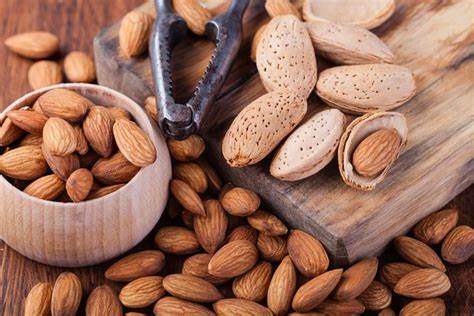
Almonds are called the king of nuts because they are high in calcium, potassium, magnesium, phosphorus, folic acid, and protein. They are higher in calcium and fiber than any other nut. Almond oil is good for the skin and almond butter is nutritious. Key nutrients in almonds include protein, fiber, calcium, iron, magnesium, potassium, sodium, zinc, copper, folate, manganese, selenium, vitamin C, and vitamin E.
Brazil nuts are gathered from trees in the Amazon basin of Brazil, this is the only variety of nut that is not cultivated. Brazil nuts are a good source of calcium, phosphorus, and vitamin B, and are among the riches sources of selenium, a vital mineral lacking in most U.S. soils and therefore in most food grown in this country. A one-ounce serving of Brazil nuts (six to eight kernels) contains over 800 milligrams, more than ten times the recommended dietary allowance (RDA) of selenium, which is 40 to 75 micrograms. These nuts have strong antioxidant properties as well! Key nutrients include protein, fiber, calcium, iron, magnesium, copper, zinc, vitamin C, folate and vitamin E.
RECIPES:
Tamari Roasted Almonds. Take 2 cups of raw almonds, 1/8 cup of low sodium tamari, and 1 splash of toasted sesame oil. Preheat the oven to 300 degrees. Measure out 2 cups of raw almonds. Lay almonds over a baking sheet and place in the oven for 10 minutes. Remove from the oven. turn the almonds over. Place in the oven for another 10 minutes. Stop and check on the almonds every few minutes, especially if your oven runs hot. Cut one or two almonds in half to see if they are still white inside. Return to the oven until golden brown on the inside. Pour almonds into a bowl. Pour tamari over them. It should steam or sizzle as you stir. Continue to stir the almonds until all of the tamari has coated the almonds and the liquid has evaporated. Then drizzle in some toasted sesame oil and stir. Turn off the oven. Distribute the coated almonds on the pan and return to the oven to dry for 10 minutes. Remove when dry. Can be stored in a container for up to 3 days.
Raw Almond Parmesan. Take 1 cup of raw almonds (either with the skins or without). 2 tablespoons of nutritional yeast, 1 teaspoon of garlic powder, 1/2 teaspoon or so of mineral or sea salt. Place all ingredients in food processor or blender and process until your desired consistency. That’s it!!! Sprinkle on soups, pasta, salads, pizzas, etc. (I love it on fish and salmon.)
Homemade Granola. (Dry ingredients) Take 2 cups of old fashioned rolled oats, 1/2 cup of oat flour, 2 tablespoons of flaxseed meal, 2 tablespoons of white sesame seeds, 3/4 cup of sliced raw almonds, 3/4 cup of raw pecans halves, 3/4 cup of raw cashews, 2 teaspoons of ground cinnamon, 1/2 teaspoon of sea salt. (Wet ingredients) 1/4 cup of coconut oil, 1/3 cup of pure maple syrup, 1 teaspoon of vanilla extract, 1/2 cup of packed dates chopped, and 1/2 cup of golden raisins. Preheat the oven to 300 degrees. Line a large baking sheet with parchment paper. In a large bowl, whisk together the oats, oat flour, flaxseed meal, sesame seeds, almonds, pecans, cashews, cinnamon, and salt. Add coconut oil, maple syrup, and vanilla extract to a small saucepan and place over low heat, stirring frequently until coconut oil is completely melted. Pour over dry ingredients and mix well until oats are completed coated. Next spread the granola evenly in the baking pan and bake for 20 minutes. After 20 minutes stir granola, and bake 15-20 minutes or until granola is just slightly golden brown. Remove from the oven and allow the granola to cool completely on the baking sheet so that little clumps stay intact. Once cooled, stir in chopped dates and raisins. Transfer to an airtight container or large glass jar. It can be stored up to 7 days. (This makes about 18 servings.)
Next week it is on to Part One that will feature cashews, chestnuts and chia seeds. Have a fabulous rest of your week everyone! Stay safe and well!
“SOMETIMES WE ARE TESTED NOT TO SHOW OUR WEAKNESSES, BUT TO DISCOVER OUR STRENGTHS.”
 Lemon and Rosemary
I enjoyed reading your post. I agree that nuts and seeds confer significant health benefits. For instance, macadamia nuts have the highest content of monounsaturated fats when compared to other types of nuts. The high content of monounsaturated fats can be very beneficial when it comes to improving heart health and reducing the risk of developing cardiovascular disease.
LikeLiked by 2 people
Thank you for the great comment! What good additional information. If it is permissible with you, I would like to include this in my next post and credit you with the submission if that is okay!!
LikeLiked by 2 people
That’s okay with me. Thank you!
LikeLiked by 2 people
GREAT!!! 🙂
LikeLiked by 2 people